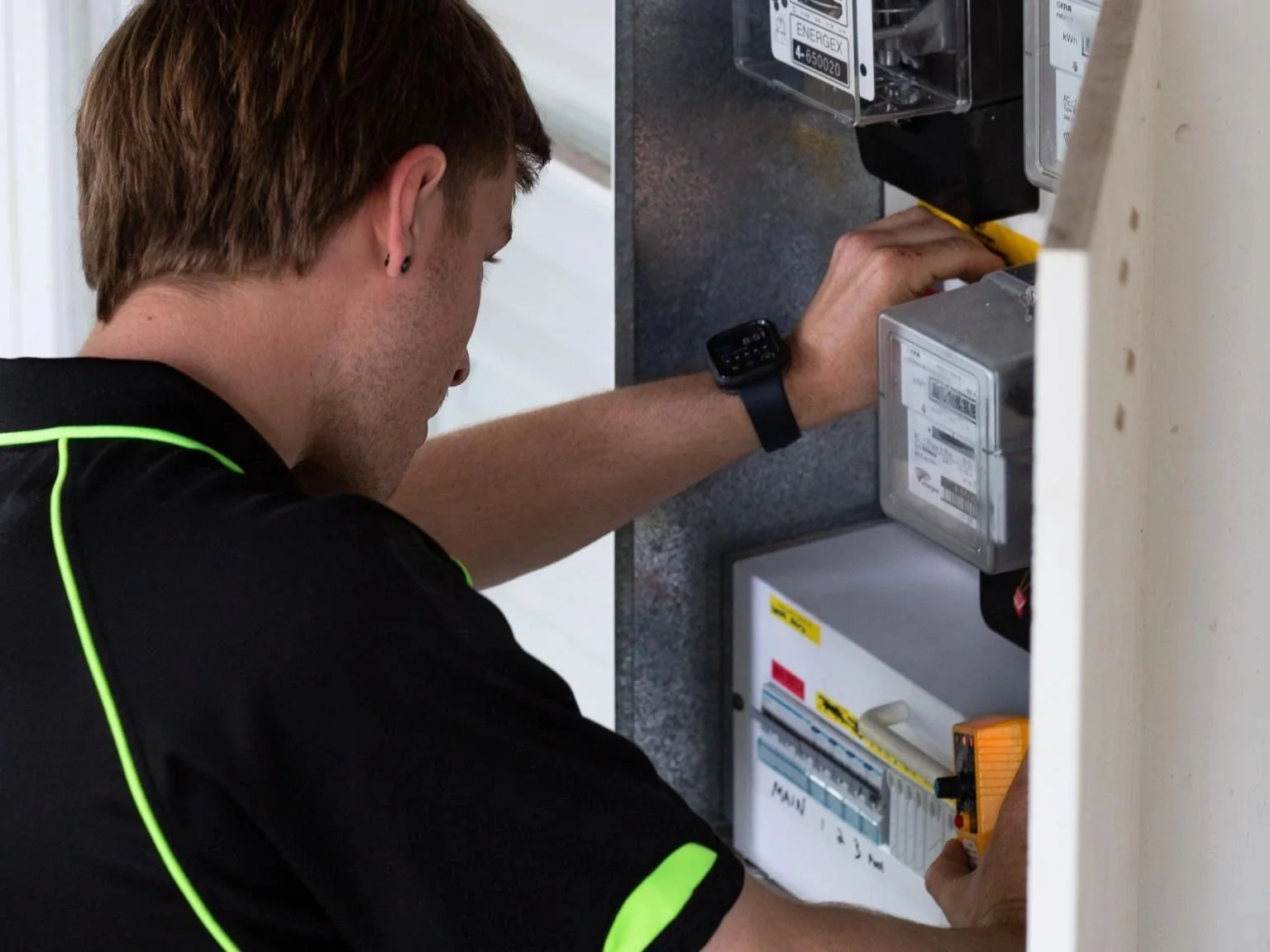
The short answer: most residential switchboard upgrades in Brisbane fall in the low- to mid-thousands in 2026. Commercial upgrades run higher — often four-to-five figures depending on board size. Meter relocations with Energex coordination add meaningfully on top. Surge protection is a modest add-on.
That's the headline. But if you've been quoted something outside that range — either suspiciously cheap or uncomfortably expensive — it's worth understanding what actually drives the cost, what a modern switchboard includes, and where the honest variation sits.
What the price range actually covers
A standard residential switchboard upgrade in the $1,800 – $3,500 range should cover:
- •Removal of the existing board (ceramic fuse, rewireable, or older MCB board).
- •Supply and install of a new modern distribution board sized for the home.
- •RCD (Residual Current Device) safety switches protecting every power and lighting circuit.
- •Modern miniature circuit breakers (MCBs) on each circuit.
- •Clear circuit labelling so anyone can identify what runs what.
- •Coordination with Energex for the temporary supply isolation.
- •Full testing and commissioning of every circuit.
- •Certificate of Electrical Safety (legally required, issued on completion).
- •Lodgement of the certificate with the QLD Electrical Safety Office.
What pushes the price up
Circuit count
A 3-bedroom home with 8 circuits is simpler than a 5-bedroom home with 14 circuits. Each additional circuit needs its own MCB, its own RCD coverage (or a shared RCD block), and its own test. Beyond about 18 circuits you're into larger board territory with higher-rated components.
Board location and access
A board in a ground-floor laundry with easy access is a faster job than a board mounted on a Queenslander's front verandah (where you need weatherproofing and often council overlay sensitivity) or in a hard-to-access meter cupboard. Access adds time; time adds cost.
Energex coordination and meter relocation
A straight board swap doesn't need the meter relocated — Energex temporarily isolates the supply, we swap the board, they reconnect. Cost stays in the $1,800 – $3,500 range. If the meter itself needs to be moved (external location change, three-phase upgrade, or underground conversion), that adds $2,500 – $6,000 including Energex connection fees, permit applications, and usually two site visits.
3-phase upgrade
Single-phase to 3-phase supply upgrade is a separate scope. Coordinated with Energex, a full conversion typically lands between $4,000 and $12,000 all-in — that figure includes the new 3-phase board, so you're not paying for the standard upgrade on top. The driver is the run from the street: where 3-phase is already at the pole and the run is a short overhead one, you're at the bottom of the range; long underground runs and transformer upgrades push toward the top. Essential for homes adding ducted air conditioning, EV charging, pool heating, or a solar battery system simultaneously.
Asbestos backing board
A lot of Brisbane homes built before the late 1980s have their original switchboard mounted on an asbestos-containing backing panel — Zelemite and similar flat electrical sheets were standard at the time. It's harmless while undisturbed, but a board swap means removing it, and that has to be done under licensed asbestos-handling procedure: controlled removal, sealed disposal, and a clearance before the new board goes on. Expect it to add roughly $300 – $800 to the job. A good electrician spots it at the site visit and quotes it up front — you don't want this discovered (and charged) as a surprise on upgrade day.
Additional compliance fixes
If the inspection reveals problems elsewhere — failing GPOs, damaged cable insulation, unbonded metallic parts, missing earthing — those become separate line items. We surface them at quote stage rather than as site-visit surprises.
What pulls the price down
Three legitimate cost-reducers:
- •Fewer circuits (smaller older homes).
- •Reusing the existing enclosure if the board location is weatherproof and big enough.
- •Bundling with other works — if we're already on site for a rewire or renovation, the board upgrade is often cheaper because we're already mobilised.
Be wary of quotes significantly below the $1,800 floor for a standard residential upgrade. The components alone — modern distribution board, RCDs, MCBs, busbars, terminals, labelling — cost $600 – $900 at trade prices. A quote at $900 – $1,200 means someone is cutting a corner: using cheap components, skipping RCD coverage on lighting circuits, or (most commonly) not pulling a Certificate of Electrical Safety. That last one is a genuine problem for you if you ever sell the home.
Signs your switchboard actually needs upgrading
- •Ceramic fuses or rewireable fuse holders in the board.
- •No RCD safety switches (you should see red or green test buttons on multiple switches).
- •The board is more than 25 years old.
- •You're adding a new circuit (air conditioning, EV charger, solar) — any renovation that adds a circuit triggers a compliance upgrade under AS/NZS 3000.
- •Burning smell or scorch marks near the board.
- •Frequent circuit trips or blown fuses.
- •Flickering lights throughout the home (not just one room).
- •Buzzing or crackling sounds from the board.
What upgrade day looks like
- 1.Site visit a few days before: photos taken, scope locked, Energex temporary disconnection booked.
- 2.Upgrade day: power off for 2–4 hours, usually in the morning.
- 3.Existing board removed, new board mounted.
- 4.Every circuit rewired to its labelled MCB, RCD protection applied.
- 5.Testing: every circuit tested for correct earth-fault clearance, every RCD trip-time verified.
- 6.Power restored. Certificate of Electrical Safety issued.
- 7.Follow-up: certificate lodged with QLD ESO, copy emailed to you for records.
The quiet benefit — insurance
Most home insurers now expect RCD-protected switchboards for full policy cover. A 40-year-old ceramic-fuse board is increasingly likely to be flagged if you claim for an electrical-fire-related loss — and in some cases claims have been reduced or denied on the grounds of non-compliance. The switchboard upgrade is partly an electrical improvement and partly an insurance de-risking move.
Bundle opportunities
If you're planning any of the following, getting them done at the same time as the switchboard upgrade saves money — one mobilisation, shared scoping, integrated wiring:
- •Ducted or multi-split air conditioning install (often triggers the board upgrade anyway).
- •EV charger pre-wiring (32A 3-phase circuit run from the board).
- •Solar inverter and battery provision.
- •Smoke alarm compliance (for 2027 deadline — see our guide).
- •Whole-of-house surge protection.
- •Partial rewire if the home also has pre-1990 circuits.
Switchboard replacement cost vs an upgrade — what's the difference?
People search “switchboard replacement cost” and “switchboard upgrade cost” interchangeably, but they're slightly different jobs. An upgrade keeps the existing enclosure where it's sound and adds modern RCDs and circuit breakers; a full replacement swaps the entire board — enclosure, busbar, mains connections and all — usually because the old board is asbestos-backed, undersized, or corroded. In Brisbane a straight switchboard replacement runs much the same as an upgrade — roughly $1,800 to $3,500 for a standard single-phase home — with asbestos removal or a 3-phase board pushing the top of that range higher. The cost drivers above apply to both.
Want a fixed-price switchboard upgrade quote for your Brisbane home?
SEE SWITCHBOARD SERVICES